The Global Fund
Data Explorer
Global Health · Data Dashboard
Visualising the global fight against AIDS, tuberculosis, and malaria. $65 billion in investments, publicly explorable.
The Global Fund Data Explorer is live.

01 / The Problem
Billions in global health funding. No single place to understand them.
Before the Data Explorer, The Global Fund's data lived across technical files, downloadable datasets, and a document-heavy Grant Portfolio, all structured for internal reporting. A journalist tracing funding to a country, or a civil society group checking eligibility, had to download spreadsheets and cross-reference by hand.
The data wasn't hidden. It just wasn't designed for anyone outside the organisation to use.
I lead design on the platform that changed that: a public explorer that moves between pledges, grants, results, eligibility, and geography without asking anyone to understand the data model underneath.
02 / The platform
Six data dimensions. One coherent experience.
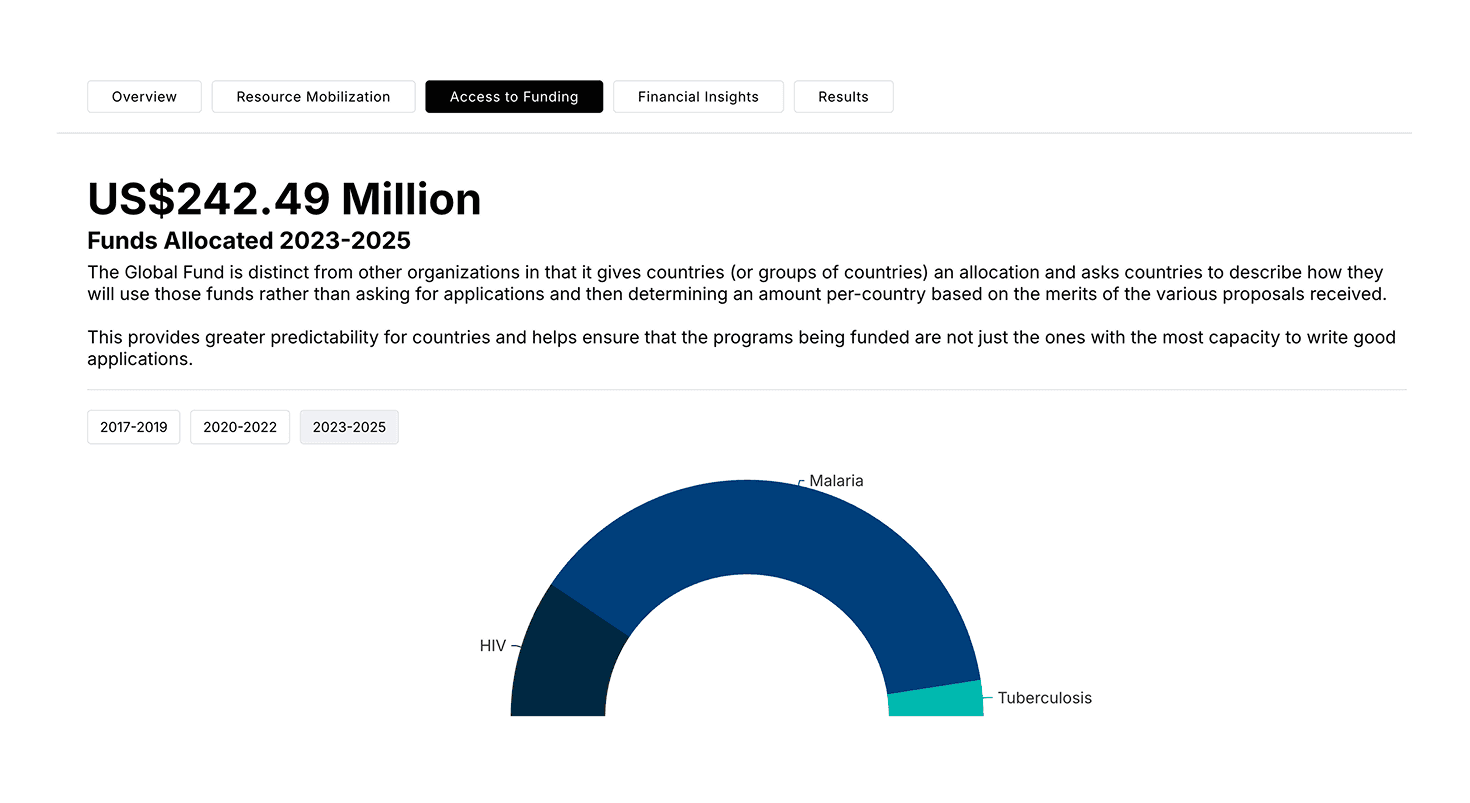
Resource mobilisation, access to funding, financial insights, annual results, grants, and geographic location. Each has its own data logic, update schedule, and primary audience: donor governments read one, recipient countries another, implementing organisations a third.
One navigation had to hold all six without making any of them wade through the others.
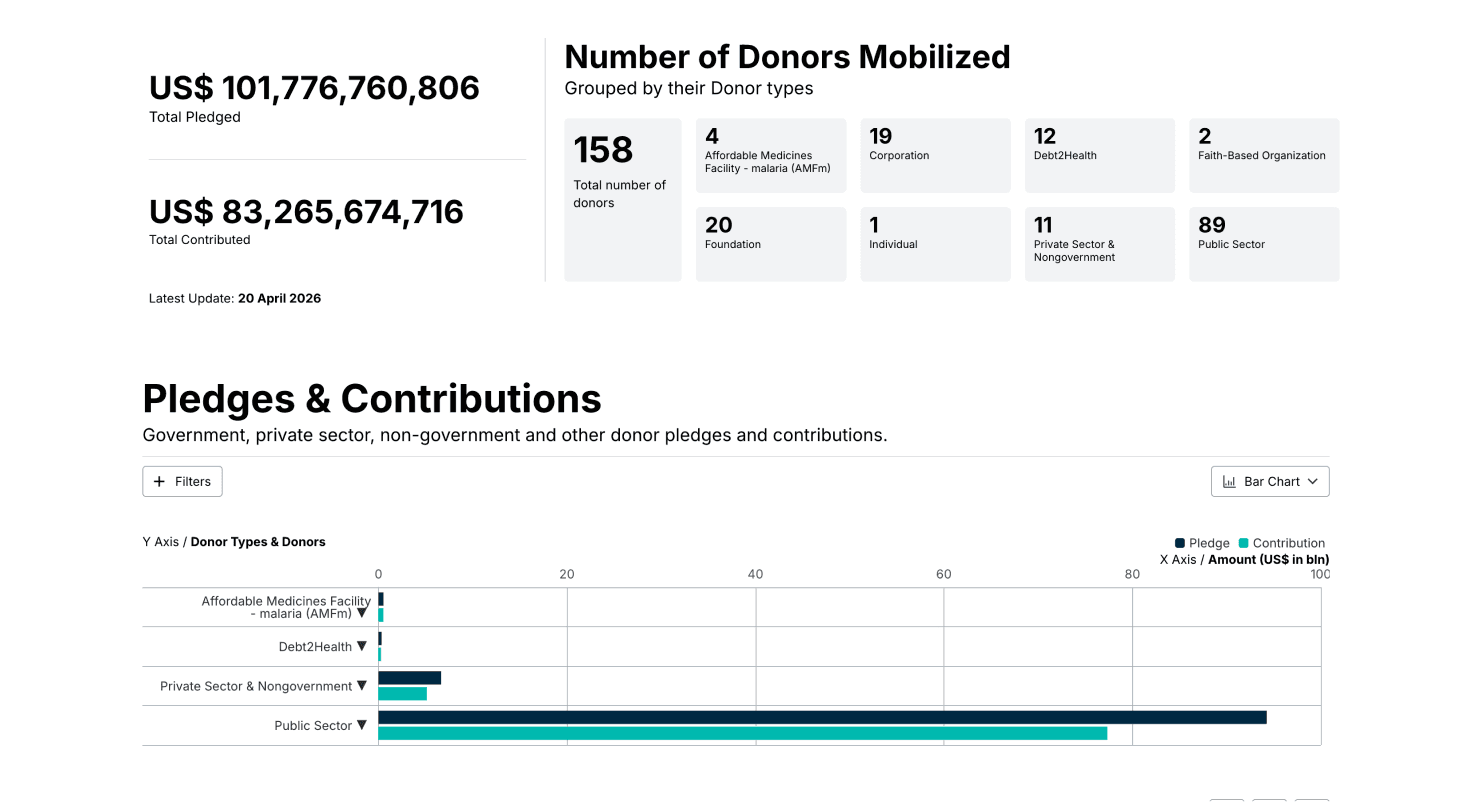
Resource Mobilisation.

Access to Funding.

Financial Insights.

Annual Results.
Geographic Location.

Grants.
03 / Audience Archetypes
The same data, read four different ways.
There's no single user of this platform. They're all looking at the same dataset and they need completely different things from it.
health ministry
Cycle-over-cycle funding trends
Resource
Mobilization / Financial Insights
Compare cycles without implying continuity the methodology doesn't support
Journalist
investigative / data desk
To verify money reaches the highest-burden regions
Annual Results / Geographic Location
Make the path from country to grant traceable and quotable
Civil society org
recipient country
To know if their country qualifies next round
Access to Funding
Surface eligibility logic without assuming knowledge of the funding model
no prior context
To understand what the Global Fund does
Homepage
Orientation before depth. No jargon to clear first
04 / How it fits together
A connected part of a larger whole.
The Explorer sits on top of the Global Fund Data Service API, alongside the Global Fund website, the Results Report, and the Data Service downloads. Knowing what already existed, and where the gaps were, shaped what it needed to be.
It also meant designing for upstream constraints. Data arrives through a middleware layer that aggregates from the Data Service. Quality varies across publishers. Update cadences differ. The interface absorbs that without pretending the data is cleaner than it is.
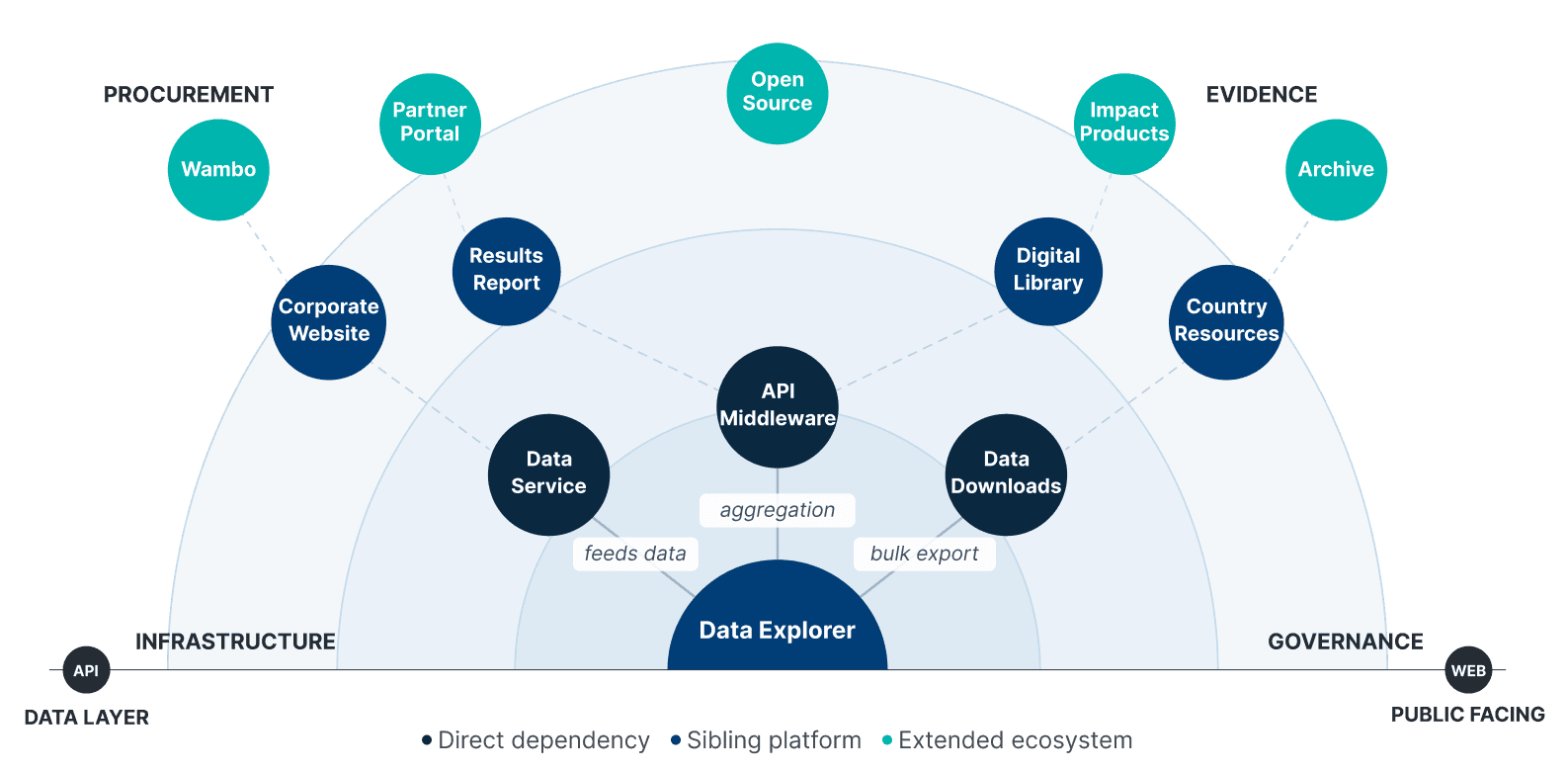
Global Fund Ecosystem Map.
05 / The hard part
When the data changes shape, the chart has to change too.
The hardest design problem on this platform wasn't layout or navigation. It was representation.
How something gets measured, categorised, or reported can shift between cycles. Not error: standards evolve. When that happens, a number from three years ago and a number from today look comparable and aren't. On a platform used for public accountability, a chart that implies otherwise is telling a false story.
Much of my work here has been deciding which visual forms are honest enough to carry the data they're given, and which imply more continuity than exists.
Continuous line. Implies a trend across years, including across a methodology change the reader can't see without the annotation.
Discrete periods. Each cluster is self-contained. The gap between them is the design doing the work, there's no line to interpolate a false story from.
Most readers never open the methodology notes, so the visual form does the interpretive work. Sometimes the honest move is to change the chart, not add a disclaimer.
06 / The system
One point of judgment.
I define one chart vocabulary across Zimmerman's products: ECharts conventions, theme, tokens, and the chart set. Shared icon and component libraries sit alongside it, project-specific components on top. I maintain the Figma side, named to match what ships in code.
I specify the chart
Client checks against the data's history
Engineering builds it
Whether a metric's history breaks depends on the metric, so it can't be a library default. It needs someone who knows that dataset. Being the single place that judgment happens is what keeps four pages from drifting apart.
Every chart can be read as a table.
A reader who distrusts the chart should be able to check it against the numbers without leaving the page. The alternative was chart-only with data through the Data Service downloads, which makes verification a separate task from reading.
Changelogs, UX evaluations, and WCAG reports run alongside. A pattern designed in 2023 gets reused in 2026 without being rediscovered.
07 / Outcomes
This platform doesn't track its users, but there are the traces it left anyway.
The Explorer doesn't track its users. It's an open data tool, so impact isn't sessions. It's who trusts the data enough to cite it and build on it.
Adopted
Cited as a primary data source by KFF (The Kaiser Family Foundation), and referenced in the Global Fund's own results reporting.
Benchmarked
Transparency context. The Global Fund's Aid Transparency Index score rose more than 10 points between 2022 and the cycle the expanded financial data launched. The Explorer is one of several public-access channels assessed.


Canonical
Became the public route into Global Fund grant data, retiring the document-heavy Grant Portfolio it replaced.
Redistributed
Picked up and redistributed by humanitarian information services, including ReliefWeb.
The four dataset pages behind these outcomes are ones I built from scratch.
08 / The Relationship
Still building, still learning the data.
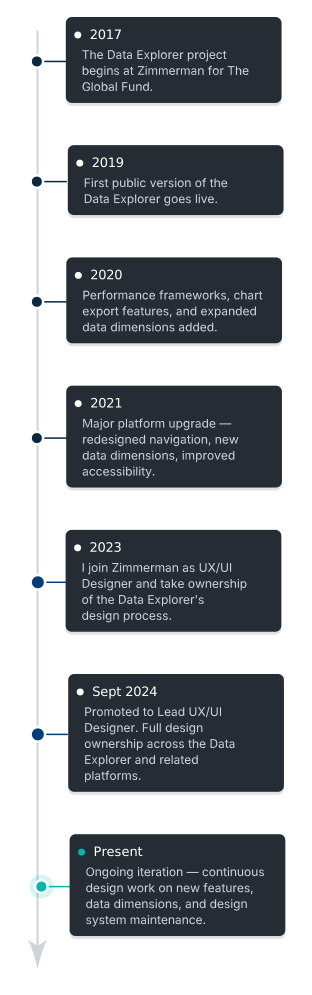
I've been designing within this data model for over three years now. That means I understand things a brief can't communicate. The Global Fund team trusts the design process because they've seen it compound over time: patterns designed once, refined through real use, not specced in isolation.

09 / Reflections
What this project taught me.
01
Data integrity is a design problem, not a data-engineering one.
The misinformation risk on this project wasn't hypothetical. A misleading chart form could inform a policy decision based on a false picture. That changed how I evaluate every visualisation I design.
02
Change the chart, not the footnote.
When annotations can't reliably carry the caveats a dataset needs, the response has to happen at the level of form. Pick a visual grammar that refuses to tell the wrong story.
03
Letting users switch chart types isn't a feature, it's a position.
There's no single correct view of a complex dataset. The designer's job is to enable good questions, not present fixed answers.
04
Long-term client relationships produce better design.
Knowing the full history of a data model and why something changed, what a metric actually tracks leads to better decisions.
10 / Take a Look