Openaid.fi
Data Visualisation · Government Transparency
Finland's entire development cooperation (every euro, every recipient, every result) in one place a minister and a curious citizen can both actually use.
Openaid.fi is live.
Role
Sole UX/UI Designer
Client
Ministry for Foreign Affairs of Finland
Location
Helsinki
Timeline
2023

01 / The Problem
The data was already public. It just wasn't legible.
Finland reports its development spending to the IATI standard. The transparency box, ticked. But IATI lives in structured XML, queryable by people with the skills to query XML. A journalist checking a claim, a student writing a thesis, a taxpayer wondering where €5 billion actually went and what it changed, none of them had a way in.
So Finland's transparency was real on paper and inaccessible in practice. The obligation was met and the point was missed. Open data that the public can't read isn't accountability; it's a compliance artifact.
RAW IATI XML
<iati-activity>
<iati-identifier>FI-3-19-0123</iati-identifier>
<title>
<narrative>Basic education support</narrative>
</title>
<recipient-country code="TZ"/>
<sector code="11220"/>
<transaction>
<value currency="EUR">4250000</value>
</transaction>
</iati-activity>
OPENAID.FI
Basic Education
Basic education support
Tanzania · 2019 · Grant
DISBURSED (EUR)
€4.25M
02 / Product Overview
A portal that shows four data dimensions.
Openaid.fi is built so that someone who has never seen a dataset and someone who lives in them can both start from where they're comfortable.

Policy priorities.
The top-down entry. Spending broken out by Finland's four priority areas, then by sector, organisation, location, and SDGs. A citizen who only knows "I care about girls' education" has a door.

Interactive charts.
The spine of the product. The drill-down from a €5bn aggregate all the way to a single project, without losing the thread of where you are.
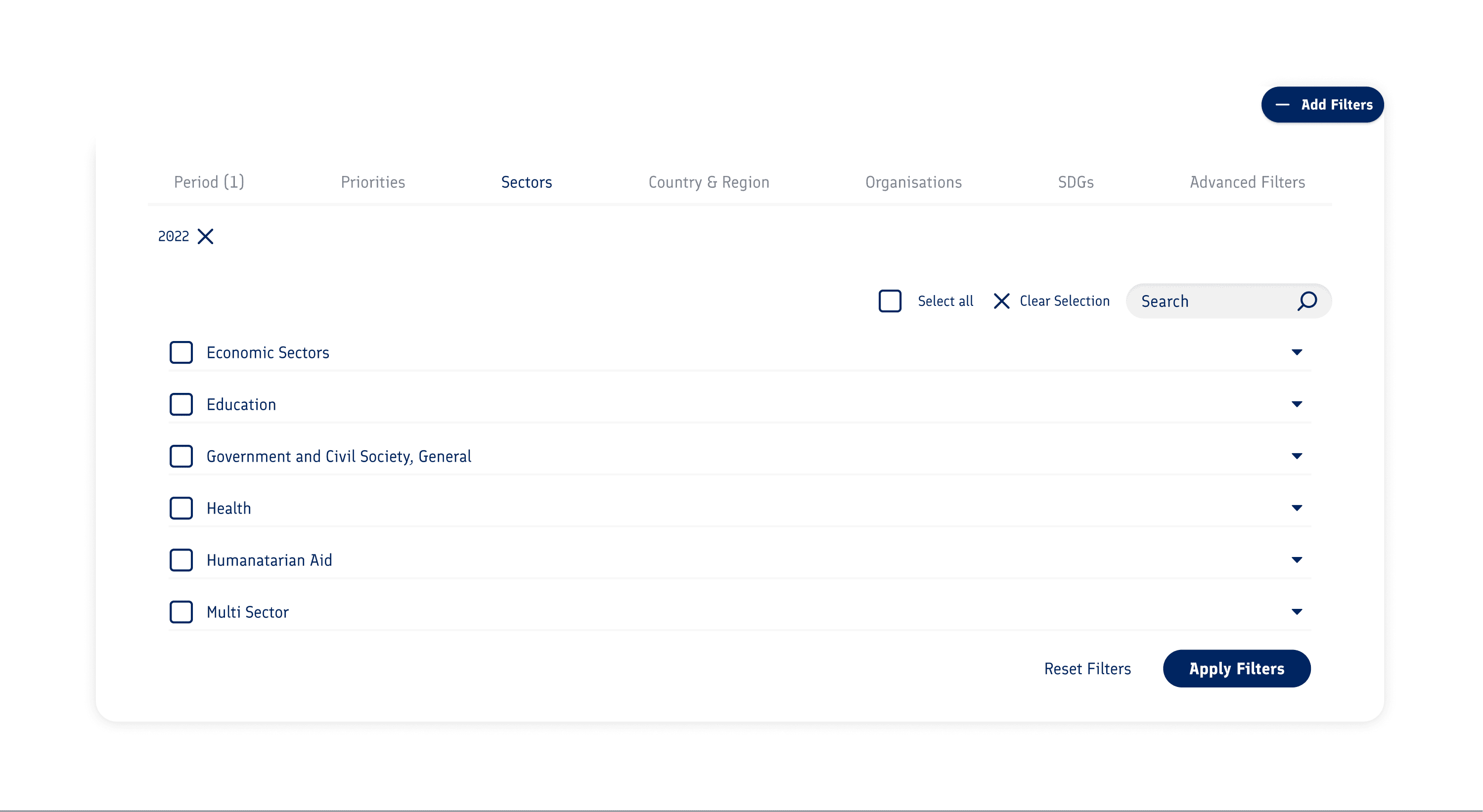
Search & filtering.
The bottom-up entry, for users who arrive with a specific question across activities and transactions.

For everyone.
Not a feature but a constraint that shaped every other one. Built to WCAG, plain-language throughout, no technical vocabulary assumed.
03 / Users
A minister and a taxpayer using the same interface.
Most data products pick one user and optimise hard. A transparency portal can't: the public and the government read the same numbers. The design has to hold both ends without talking down to either.
I designed around two profiles. A Ministry analyst pulling figures for policy: fluent, fast, impatient with anything slow. An interested citizen with one honest question, who leaves in fifteen seconds if the first screen looks like a spreadsheet.
Not a simple mode and an advanced mode. One surface: easy entry points on top (priority areas, guided filters), depth one layer down (transactions, raw figures). Never hidden, never the first thing you hit.
Ministry Analyst
Government · Policy & Oversight
Goals
Track how development aid is allocated and verify spending against policy commitments.
Needs
Reliable, structured data with exportable reports for briefings and audits.
Frustrations
Fragmented sources, inconsistent formats, and slow access to current figures.
OpenAID Ministry Analyst Persona.
Interested Citizen
Public · Taxpayer
Goals
Understand where national aid money goes and whether it makes an impact.
Needs
Plain-language summaries and clear visuals that need no prior expertise.
Frustrations
Jargon-heavy portals and data that feels impossible to interpret.
OpenAID Interested Citizen Persona.
04 / Three languages, one structure
Trilingual translation was an architectural decision.
Openaid.fi ships in Finnish, Swedish, and English (Finland's two official languages plus the international audience for aid data). Translation is the easy part. The hard part is that label length, search behaviour, sector terminology, and reading order all shift between languages, and the same layout has to stay legible and trustworthy in all three.
That meant designing for the language as a variable from the start: components that absorb a 40%-longer Finnish compound word without breaking, a data dictionary aligned across all three so a "sector" means the same thing whichever language you arrive in, and a search that works when a citizen types the Finnish term and the dataset holds the English one.
Getting this right is invisible when it works and glaring when it doesn't, which is exactly the kind of detail a government portal is judged on.
05 / The core interaction
From five billion euros to one project, without getting lost.
The whole portal lives or dies on one movement: an aggregate that means nothing on its own (€1.67bn in 2022 ODA) becoming something a person can hold — this much went to this organisation, for this project, in this country, with these results.
The design problem in a deep drill-down isn't the data; it's orientation. At every level the user has to know where they are, how they got there, and how to get back without starting over. I treated the breadcrumb trail, the persistent totals, and the "what am I looking at" framing as the load-bearing parts — the charts themselves are the easy bit.
06 / Key Design Decisions
Where the real design thinking happened.
Chosen
Layered depth on a single surface.
Easy entry points (priority areas, guided filters) on top; activity- and transaction-level detail always one layer down. One product, two literacy levels. Alternative considered
Alternative Considered
A "simple" public site and a separate "expert" tool.
Cleaner on paper, but it splits an audience that genuinely overlaps and quietly tells citizens the real data is somewhere they're not invited.
Chosen
Entry by what people care about, not how the data is structured.
Lead with policy priorities and SDGs — human categories — rather than the IATI schema underneath.
Alternative Considered
Exposing the data's native structure first.
Faithful to the source, alienating to everyone who doesn't already think in IATI fields.
Chosen
Accessibility as a constraint, not a pass at the end.
WCAG and plain language shaping the design from the first screen.
Alternative Considered
Ship, then remediate.
Standard, and a quiet way of deciding which citizens the word "everyone" actually covers.
08 / Reflections
What I'd carry into the next project.
01
Publishing data and making it public are two different jobs.
Finland had already done the first. The design work was the second, and it's the one that actually delivers on what transparency promises.
02
Designing for the widest audience raises the bar for the expert too.
Forcing the interface to work for a citizen with no background didn't dumb it down for the analyst. Clearer entry points and honest labels made it faster for everyone.
03
On a national portal, the invisible details are the credibility.
Trilingual layouts that don't break, totals that always reconcile, a drill-down you can't get lost in, none of it is flashy, and all of it is what makes a government's data feel trustworthy.
09 / Take a Look
OpenAid.fi is live.
11 / Keep Exploring